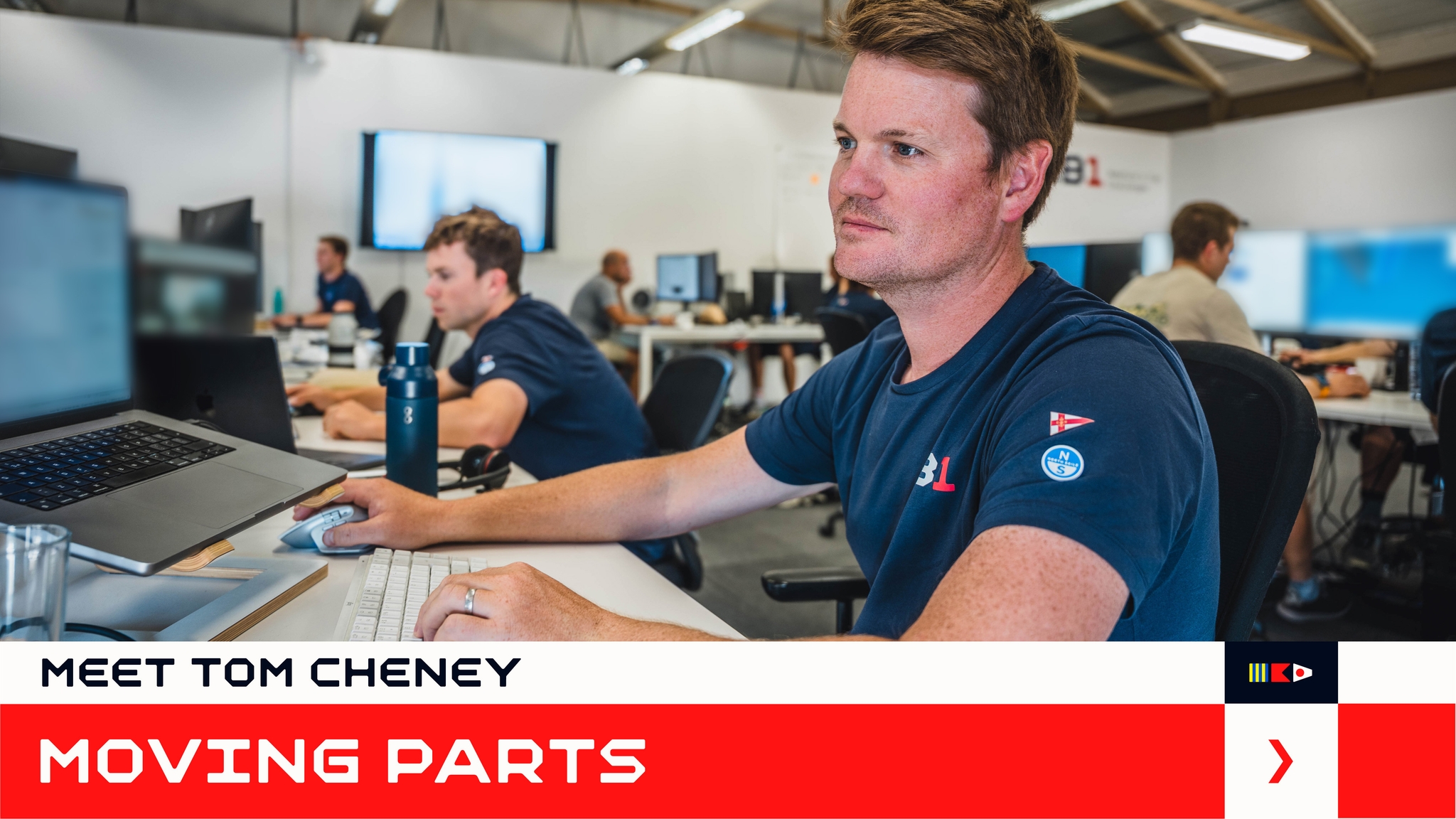
Moving Parts | Tom Cheney
Tom Cheney is Head of Software and Data at GB1, where he oversees everything from the software and displays running on the boat to how data is collected, stored and analysed. This is his fourth America’s Cup campaign, having joined the team in 2015, and over the past decade he has seen the role of software and data evolve alongside the sport.
“I’m Tom Cheney, Head of Software and Data for GB1, which is pretty broad. Everything from the software and displays running on the boat, through to how we get data off the boat, store it in cloud services, and then do a lot of work to automate the analysis of all that data. We produce performance reports and ultimately try to contribute to making the boat better and faster.”
At its core, Tom’s role is about turning huge amounts of information into something the wider team can use. “A lot of what we do is similar to what you might do in finance or other industries, where you’re taking large quantities of data, figuring out how to process it, extracting useful metrics and learnings from that data, and then applying them to the rest of the business.”
But despite the technical nature of the job, it isn’t all spent behind a desk. “I think people would be surprised at just how dirty you end up getting your hands. You’re not always sat at a desk. Quite a lot of the time we’re in a crummy 40-foot container, crawling around in the bowels of a boat, or playing with electronics on a chase boat.”
The role has changed significantly since Tom joined the team. “This is campaign number four for me. I signed up at the end of 2015. Over the last three campaigns, it’s been really exciting to see how the organisation has developed and grown up.”
The America’s Cup itself has evolved dramatically, too. “If I look back to the 2017 campaign, they were a much more agricultural version of what we’re doing now. It was so much simpler than what we’re trying to do with this fourth iteration and the AC75.”
Today, one of the biggest priorities for the software and data team is making information accessible across the organisation. “Most of what we do day to day is try to democratise access to all this data. We pull data off boats, simulators and test rigs. We do some of the data analysis ourselves, but ultimately what we’re trying to do is get access to data, learning and information in front of as many people as possible.”
That means engineers, designers and sailors can all engage with the information themselves and use it to make decisions. “We’ve got really bright people, and if we can put data in front of them, they can make better and faster decisions.”
The pace of development is relentless. The team works towards a roadmap of major milestones, from the first day of AC40 sailing to the first minute of flight, launching a new boat or building a simulator.
Tom’s role has also become increasingly focused on management. “We divide the work up, and we have a stand-up meeting every morning at 9am where we go through what we did yesterday, what we’re doing today, and all the new things that have been thrown at us overnight that we hadn’t anticipated.”
And while the aim is to spend as much time as possible developing new tools, being on site and at training camps inevitably brings a certain amount of firefighting.
“We’re constantly asking what’s the next thing we’re trying to get on the boat that we think is going to be our next big performance gain.”
For Tom, that problem-solving element is one of the most enjoyable parts of the job. “We try to develop so quickly, and whilst we have lots of very rigorous testing processes, when you’re developing fast and you first try to slot all these bits of software and hardware together on the boat, you inevitably have little niggles to work through.
“I think that’s the bit I like most — trying to solve those little problems, work really fast and get stuff done.”
The America’s Cup development cycle has changed, too. With the expectation of a Cup every two years, the team is now working on much shorter development cycles.
“Every six weeks, sometimes more often, we try to deliver something for the sailing team. It’s a much shorter cycle of working out what we’re going to make available to people and then trying to deliver it.”
The wider Athena Sports Group also provides opportunities to continue developing these tools in a live racing environment. “Whilst my focus is mostly on GB1, the breadth of teams we have across the whole sports group means we’ve got access to a SailGP team that goes and races every few weeks. We get to use that opportunity to keep developing our tools in that space.”
Tom’s journey into the America’s Cup began with a lifelong connection to sailing and technology. “I grew up about as far from the sea as you can get in the UK, but I did grow up in a sailing family. My dad’s a keen sailor and we’ve always had a little family boat on the Solent.”
A visit to an America’s Cup event in Cowes helped spark his interest in combining the two. “Seeing the boats racing around, with Oracle and all the technology, was just the coolest thing I’d ever seen. I think something clicked at that point and I thought, ‘I want to do something to do with that.’”
Tom initially studied electronics at university before moving towards software and computer science, later working with sailing-related and marine engineering companies.
Then, in 2015, the opportunity to join the America’s Cup team arrived almost on his doorstep. “The first team base popped up about two miles from my house in Portsmouth. I met somebody at Portsmouth Sailing Club who was giving a talk about the challenges they were facing, and I thought, ‘Those sound like things I can help with.’ From there, I kind of grew into the role.”
For anyone looking to follow a similar career, Tom believes there are more opportunities than young people might realise.
“I’d suggest studying science, or even just picking up some projects that you’re interested in and running with them. The speed at which you can develop things with AI now is incredible. Have a go, do something and get yourself noticed. We’re desperate for people.”
He also wishes he had approached his own career with a little more confidence. “My advice to my younger self would probably be to have a bit more self-belief and determination.”
Tom believes the biggest misconception is that careers at this level are inaccessible. “When you’re in the door, you realise it’s just a group of really passionate people trying really hard. They’re not the cleverest people in the world or the best of the best. They’re generally just really good, really passionate people applying themselves and trying to do something as a team.”
For Tom, that is particularly important when encouraging young people into STEM careers. “It’s about taking maths and science out of the classroom and actually using it to try to do something fun and exciting. That’s the key to making it more interesting.”
The skills he uses every day reflect the collaborative nature of the role: “Teamwork, problem-solving, critical thinking, design and coding.”
And while coding remains central to his work, Tom believes being able to work effectively with people from different disciplines is just as important.
“We’ve got such a diverse group of talent, with many different disciplines of engineering scattered around the office. A lot of the time, as a software engineer, you’re trying to facilitate those people applying their areas of engineering to the bigger project.”
After more than a decade of trying to win the America’s Cup, Tom knows exactly what is at stake.
“The best day by far in a decade of doing this was standing on that stage and lifting the trophy. We felt how tantalisingly close we’d got to lifting the old mug, and I think that made it feel worth however many years of effort it had been by that point.”
But the ultimate prize remains the goal.
“Having been pushing hard at this for more than a decade, trying and trying to actually win the America’s Cup, I almost don’t know what it would feel like to win it.”
There have been disappointments along the way, from early campaigns that ended in heartbreak to the highs and lows of winning the Louis Vuitton Cup before falling short in the America’s Cup.
“I’m certain that we’ll get there, and I’m certain it will be absolutely life-changing. It would be incredible.”